


Our Apps Have Driven
5X AOV | 2X Conversions | $30M+ Additional Revenue
5X AOV | 2X Conversions | $30M+ Additional Revenue


5.0 (3000+ Reviews)


Shopify Apps





More traffic doesn’t always translate into more revenue. If your website has unclear product messaging, friction-heavy navigation, or a complicated checkout process, you could be losing customers who are already ready to buy.
Baymard Institute reports an average ecommerce cart abandonment rate of 70.22%, highlighting how much purchase intent goes unrealized. Conversion rate optimization (CRO) helps you identify these bottlenecks, streamline the buying journey, and turn more existing visitors into customers without increasing acquisition spend.
This guide covers 20 practical CRO tips, tools to analyze visitor behavior, and a step-by-step strategy to improve your website conversion rate.
Conversion rate optimization (CRO) is the process of improving a website or landing page to increase the percentage of visitors who complete a desired action. This could mean purchasing a product, submitting a form, booking a demo, or signing up for a newsletter.
CRO combines analytics, user research, usability improvements, and experimentation to understand why visitors convert or leave without taking action. These insights help businesses identify the most relevant CRO tips for their websites.
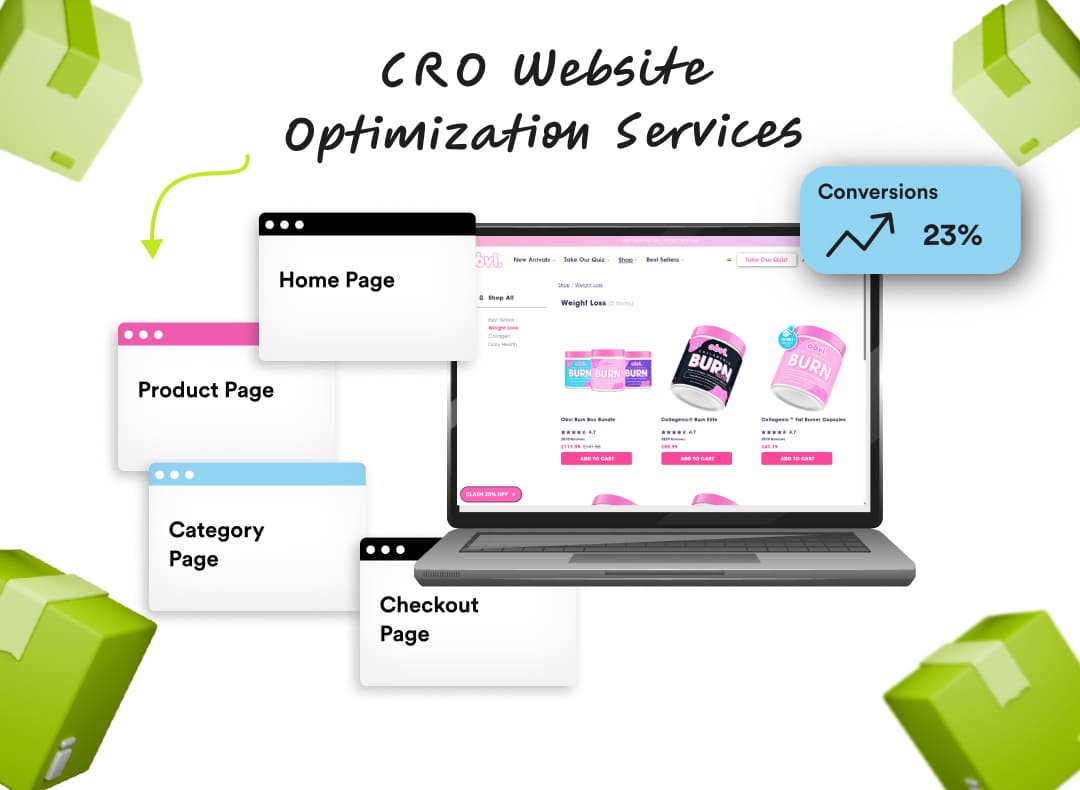
Businesses can also use CRO website optimization services to identify conversion barriers, prioritize improvements, and test changes that help turn more visitors into customers.
Calculate your website conversion rate by dividing the number of conversions by the total number of visitors or sessions, then multiplying by 100.
Conversion rate = (Conversions ÷ Total visitors) × 100
For example, if your ecommerce website receives 10,000 visitors and generates 250 orders, its conversion rate is 2.5%.
Use a consistent measurement method when comparing performance across pages or reporting periods. Visitor-based and session-based conversion rates measure different things, so avoid comparing them directly.
There is no universal conversion rate that every website should target. Performance varies by industry, traffic source, product price, audience intent, and purchase complexity.
An ecommerce store selling everyday essentials may convert differently from a store selling premium furniture. Similarly, visitors arriving through branded search may convert at a higher rate than those discovering a brand through social media.
Instead of chasing a generic benchmark, compare your conversion rate with your historical performance, relevant industry benchmarks, and results across channels and landing pages. Use these comparisons to identify realistic improvement opportunities.
Macro-conversions are the primary actions a business wants visitors to complete, such as purchasing a product or requesting a demo.
Micro-conversions are smaller actions that indicate progress toward the main goal, including viewing a product page, adding an item to the cart, or starting checkout. Tracking both helps you identify where visitors lose interest and which steps need improvement.
Use product imagery to communicate value, demonstrate use cases, and address purchase objections. Among practical CRO tips for product pages, showcasing product scale, fit, installation, and real-world applications helps shoppers evaluate products before buying. Show product scale, fit, installation, and real-world applications so shoppers can evaluate product-market fit before reaching the buying decision.
Long product pages can create friction when shoppers have to scroll back to purchase. Test a sticky Add to Cart bar that preserves visibility of the primary CTA while keeping the selected variant and price clear.
Keep size, colour, and pack options close to the product gallery and primary CTA. Display availability at the variant level and update pricing and imagery dynamically. On mobile, aim for tap targets of at least 44 × 44 CSS pixels, with sufficient spacing between adjacent options to reduce accidental selections. These ecommerce CRO improvements make product selection easier and reduce friction before shoppers add items to their carts.
Surface relevant return policies, warranty coverage, compatibility details, and product testing information near the buying decision. Prioritise proof that addresses actual customer objections instead of adding generic trust badges without context.
Unexpected shipping charges and additional fees can disrupt purchase intent. Surface available cost information before checkout, and provide a shipping estimator where delivery charges depend on the shopper's location. Only Shopify stores can customise their Shopify checkout, with available editing options depending on the plan. Make delivery costs and other applicable charges clear as early as possible in the buying journey.
Keep unavailable product pages accessible and preserve their search value. Offer back-in-stock notifications, relevant product alternatives, and clear availability information. This helps shoppers find another route to purchase instead of abandoning the journey entirely.
Audit zero-result searches, common misspellings, synonyms, and alternative product terminology. Improve search relevance and product tagging so shoppers can find the right products without knowing your catalogue's exact naming conventions.
Design filters around the attributes that influence buying decisions in your category. Options such as skin type, compatibility, room size, intended use, or gift budget can help shoppers narrow the catalogue based on their needs.
Surface verified reviews, customer photos, and relevant product feedback where shoppers evaluate their options. Prioritise evidence that addresses category-specific concerns, such as durability, fit, performance, or ease of use.
When shoppers struggle to distinguish similar products, make the differences explicit. Compare meaningful attributes such as materials, capacity, compatibility, included accessories, and warranty terms to reduce decision friction.
Make estimated delivery windows available on product pages or in the cart. Where possible, calculate estimates using the shopper's postcode to set expectations before checkout and reduce uncertainty around fulfilment.
For products with recurring purchase options, compare subscription pricing with the one-time purchase price. Clearly communicate savings, delivery frequency, renewal terms, and cancellation conditions to help shoppers evaluate the offer without hesitation.
Analyse pre-purchase enquiries, live-chat transcripts, and support tickets to identify recurring objections. Translate those insights into product-page copy, FAQs, compatibility guidance, or policy details that resolve questions before they become conversion barriers.
Track the progression from product views to Add to Cart, checkout initiation, and completed orders. Segment conversion data by device, acquisition channel, and product category to identify where meaningful drop-offs occur before prioritising optimisation work.
Combine session recordings, heatmaps, and behavioural analytics to investigate patterns such as repeated policy checks, frequent variant switching, or cart additions followed by removals. Validate the underlying friction before implementing a solution.
Match the landing experience to the visitor's stage in the buying journey. Research-oriented traffic may need comparisons or buying guides, while high-intent campaigns should direct shoppers to relevant product pages with clear value propositions and purchase paths.
Reduce repeat effort by retaining cart contents and selected variants where technically possible. Use consent-based abandoned-cart reminders to bring shoppers back to the products they considered, rather than relying solely on generic promotional messaging.
Display how much more a shopper needs to spend to qualify for free shipping. Recommend relevant complementary products when they help customers complete their purchase, while monitoring conversion rate, average order value (AOV), contribution margin, and fulfilment costs to ensure the threshold improves overall performance.
Baymard Institute reports that 17% of US shoppers abandon orders because checkout is too long or complicated. Its research also found an average of 11.8 form fields across checkout flows, compared with an estimated eight needed. Remove unnecessary fields and analyse payment errors by device to identify friction and improve checkout completion.
Build an optimisation backlog from customer feedback, analytics, support insights, and observed usability issues. Prioritise changes by potential conversion impact and implementation effort, run controlled tests when traffic supports reliable results, and evaluate completed orders and revenue rather than treating CTA clicks as the end goal.
Low-traffic websites may not generate enough visitors to run statistically reliable A/B tests quickly. Focus on resolving obvious usability issues and gathering qualitative insights before experimenting with smaller changes. A CRO marketing agency can also help prioritise high-impact improvements when limited traffic makes quantitative testing difficult.
Start with product pages, pricing pages, checkout, and landing pages that attract visitors with clear purchase intent. Review analytics, page usability, and customer feedback to identify friction that could prevent conversions.
Monitor actions such as product views, CTA clicks, add-to-cart events, and checkout starts. These signals help you understand where visitors lose interest, even when completed purchases are limited.
Review customer support questions, conduct short user interviews, and collect feedback through on-page surveys. These methods can reveal confusing messaging or missing information without requiring large traffic volumes.
Effective CRO involves more than making random website changes. Follow a structured process to identify problems, prioritize improvements, and evaluate their impact through CRO testing and continuous optimization.
Choose a primary goal, such as purchases, demo requests, or qualified leads. Track supporting metrics, including conversion rate, AOV, checkout completion, and revenue per visitor, based on your business model.
Map the journey from the landing page to the final conversion. Identify stages with unusually high abandonment and investigate possible causes before deciding what to change.
Analytics show where visitors drop off, while qualitative research helps explain why. Applying these CRO tips together helps you identify conversion barriers and make more informed optimization decisions. Combine funnel reports with session recordings, customer interviews, support tickets, and survey responses to build a clearer picture.
Turn each identified problem into a hypothesis. For example, "Showing delivery estimates on product pages will increase add-to-cart rates by reducing uncertainty about shipping."
Define the change, expected outcome, and primary metric before implementing it.
Address high-impact problems that require reasonable effort first. Consider potential revenue impact, confidence in the evidence, implementation cost, and technical complexity when building your CRO roadmap.
Compare the existing page with a variation that changes a specific element. Estimate the required sample size before launching, and allow the experiment to run long enough to account for normal traffic fluctuations.
Avoid declaring a winner based on a few conversions or stopping a test as soon as results appear favorable.
Check that tracking, variants, CTAs, forms, and checkout flows work correctly. Test across relevant devices and browsers, and verify that visitors are assigned to the correct experiment groups.
Evaluate the primary metric alongside guardrail metrics, such as average order value, revenue, or form quality. Record the hypothesis, test setup, outcome, and lessons learned.
Implement validated improvements, investigate inconclusive results, and use each experiment to inform your next round of CRO work.
The right tools help you understand visitor behavior, measure conversions, and test improvements. Choose tools based on your website's traffic, budget, technical requirements, and existing analytics setup.
Check each tool's current features, privacy requirements, and plan limits before choosing one.
Choose an experimentation platform that fits your development resources, traffic levels, and testing needs. Verify current product availability and pricing before implementation.
Start with Google Analytics 4, Google Search Console, and Microsoft Clarity to understand performance and visitor behavior. Use a conversion rate calculator to compare results across periods, pages, or campaigns. These tools can reveal improvement opportunities before you invest in a larger CRO platform.
For ecommerce businesses, CRO helps turn existing traffic into more orders while making the shopping experience easier. The following benefits explain why ecommerce CRO tips deserve a place in your growth strategy.
Improving the percentage of visitors who purchase can increase orders without requiring a proportional increase in traffic. For example, raising conversions from 2% to 2.5% across 10,000 visitors means 50 additional orders, assuming the same measurement basis and traffic volume.
Actual revenue gains depend on order value, margins, and customer behavior.
When more visitors convert, your existing advertising and marketing spend can generate more customers. CRO can improve campaign efficiency, although results depend on acquisition costs, order value, and the quality of the traffic.
Clear product information, intuitive navigation, and reliable checkout make purchasing easier. Implementing practical CRO tips around these elements can also support customer confidence and encourage repeat purchases. Transparent policies and consistent experiences can also support customer confidence and repeat purchases.
Conversion rate alone does not show whether your changes improve business performance. Track complementary metrics to understand the broader impact.
Together, these metrics help you distinguish genuine improvements from changes that increase conversions but reduce order value or profitability.
Along with applying these CRO tips, use the following checklist to identify practical improvements before building a broader experimentation program.